
Key takeaways
- Compare bird feeders for small birds with protective cages, fine ports and clinging surfaces sized for finches, chickadees and nuthatches in any backyard.
What's inside
As an Amazon Associate I earn from qualifying purchases. This post may contain affiliate links at no extra cost to you.
Small birds lose at most backyard feeders for a simple reason: the feeder was never sized for them. A chickadee weighs little, feeds quickly, and prefers to grab a seed and retreat, while starlings, grackles, and squirrels can monopolize a wide-open port or tray for hours. A feeder built for small birds flips that balance, using a protective cage, fine seed ports, or short perches that little legs handle easily and larger visitors cannot use comfortably.
The Mosloly Caged Tube Feeder leads this list because its cage openings are measured for small birds and stated in the listing, creating a feeding space bigger birds cannot enter. The Brome Squirrel Buster Finch follows a different path, pairing tiny Nyjer ports with a weight-sensitive shroud. These picks serve apartment balcony birders with one small hanging spot, gardeners whose finches get bullied away from a general feeder, and anyone who wants a dedicated station for chickadees, goldfinches, and nuthatches. Selections came from Amazon listings, comparing cage dimensions, port style, target species, and how each design limits access by size.
Quick Picks
As an Amazon Associate we earn from qualifying purchases.
| Product | Best for | Key spec |
|---|---|---|
| Mosloly Caged Tube Feeder | A protected space only small birds can enter | Cage openings averaging 1.27 x 1.73 inches around a tube feeder with tray |
| Woodlink WLC6S Caged Seed Tube Feeder | Mixed seed for chickadees and nuthatches | Powder-coated metal cage over a 6-port tube holding 1.25 lb |
| Brome Squirrel Buster Finch | Nyjer seed specialists such as goldfinches | 8 feeding ports and 2.4 lb thistle capacity with a closing shroud |
How to Choose
Let the cage opening decide who eats
A cage is the clearest size filter in bird feeding. Mosloly publishes its opening size, an average of 1.27 by 1.73 inches, and states the feeder is designed specifically for small birds while keeping out squirrels and medium and large birds. When a listing gives a measurement like that, you can judge it against the birds you want: finches, chickadees, and wrens slip through gaps that block a starling’s shoulders. A cage also gives small birds a grid to cling to while they work out whether the inside feels safe.
Match port size to the seed small birds actually eat
Tiny birds thrive on small seed. Nyjer is so fine that it needs purpose-built narrow ports, which is exactly the design of the Squirrel Buster Finch, while a standard tube port handles sunflower chips and mixed seed for chickadees and titmice. Read the listing’s seed guidance before assuming a feeder suits your birds. Putting Nyjer into a wide port wastes seed on the ground, and putting large sunflower seed into a finch port leaves birds pecking at food they cannot extract.
Think about perching versus clinging
Chickadees and nuthatches are natural clingers, happy on wire mesh or a cage grid, while finches settle happily on a small perch. The Squirrel Buster Finch covers both styles, with four ports carrying perches and four left bare, and its perches can be removed entirely to turn it into a clinging-only feeder that discourages bigger birds. If your regulars are mostly clinging species, a caged tube with plenty of grid surface gives them room to feed side by side without competing for a single peg.
Balance protection with cleaning effort
Every barrier that keeps a grackle out also slows you down at refill time. Caged feeders need the cage lifted or opened, and fine Nyjer ports clog faster than wide ones when seed gets damp. Check how the listing describes access: Mosloly highlights detachable parts for cleaning, and Brome designs its feeders to come apart by hand. A feeder you dread scrubbing will quietly grow mold, and small birds, with their fast metabolisms and frequent visits, are the first to suffer from spoiled seed.
Size the capacity to a small flock
Little birds eat little at a time, so a modest reservoir that turns over weekly is healthier than a giant tube holding seed for a month. The Woodlink cage holds 1.25 lb, a sensible scale for a chickadee flock, while the finch feeder’s 2.4 lb capacity works because Nyjer stays dry inside a ventilated tube. Brome’s seed ventilation design lets humid air escape at the top, a detail worth valuing if your climate is damp and your feeder hangs in shade.
The 3 Best Options
Mosloly Caged Tube Feeder — OUR TOP PICK

This feeder wraps a seed tube in a metal cage and then adds a tray beneath, and the listing is unusually precise about who the design serves. The cage openings average 1.27 by 1.73 inches, sized so finches, bluebirds, goldfinches, and similar small species pass through while squirrels and larger birds stay outside looking in. Inside the cage, birds feed with a barrier between them and any hawk or bully bird, which changes their behavior: they linger longer instead of snatching and fleeing. The assembly breaks down into tray, cage mesh, tube, handle, and lid for washing, and the metal build shrugs off weather that cracks thin plastic tubes.
Specs
- Cage openings: average 1.27 x 1.73 inches, per the listing
- Seed capacity: listed at 2.8 lb, with 3 lb of mixed seed in the maker comparison
- Target species in the listing: finch, bluebird, goldfinch, mockingbird
- Recommended use in the listing: small birds
- Material: metal, weatherproof finish
- Included parts: tray, cage mesh, tube, handle, lid
- Item weight: 4.07 lb; model KD-BLUE
Best for: Birders whose small birds get chased off open feeders, and anyone wanting a cage with published opening dimensions rather than guesswork.
Watch out for: Shy birds may take days to accept entering a cage, so scatter a little seed on the tray at first; the protective grid also means you cannot watch quite as unobstructed a view as an open tube gives.
Woodlink WLC6S Caged Seed Tube Feeder
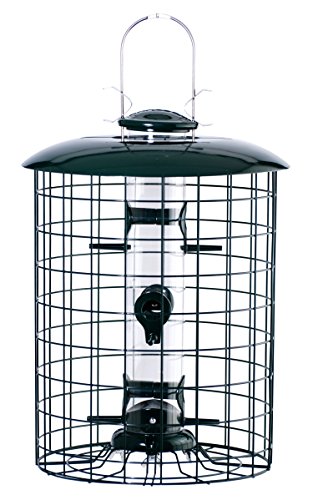
Woodlink’s approach pairs a classic six-port tube with a powder-coated metal grid cage, and the listing names exactly the small crowd it suits: chickadee, finch, junco, nuthatch, and woodpecker. The die cast steel top and bottom give the tube a sturdier frame than all-plastic designs, and the polycarbonate tube keeps the seed level visible at a glance. The cage grid doubles as a climbing surface, so nuthatches and downy woodpeckers can work their way around the outside while smaller birds feed at the ports inside. It arrives fully assembled and is sized for hanging about five and a half feet up, a comfortable height for filling from a step or a short reach.
Specs
- Seed capacity: 1.25 lb of mixed seed
- Feeding ports: 6, inside a powder-coated metal grid cage
- Tube: polycarbonate, with die cast steel top and bottom
- Target species in the listing: chickadee, finch, junco, nuthatch, woodpecker
- Mounting: hanging, with pole mounting on a 1 inch pole described by the maker
- Assembly: arrives fully assembled; suggested hanging height 5.5 feet
Best for: Yards wanting one caged station for mixed seed that serves chickadees and nuthatches now, without the refill burden of a large hopper.
Watch out for: The modest capacity means a busy flock can empty it in days during winter, and the cage spacing is aimed at excluding squirrels and large birds rather than the very smallest sparrow disputes.
Brome Squirrel Buster Finch

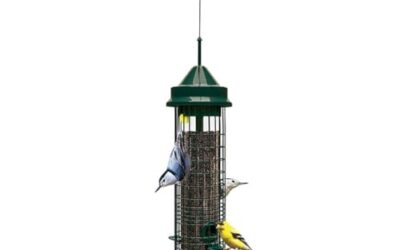
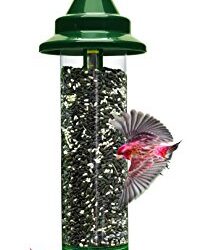
Goldfinches and siskins feed differently from seed-cracking birds, hovering and clinging at tiny ports to pull Nyjer one seed at a time, and this feeder is purpose-built for that style. Eight ports serve a whole finch flock at once, split between four perched stations and four clinging stations on the wire shroud. When a squirrel climbs on, its weight pulls the shroud down and seals the ports, and the negative grip tube stops squirrels from hanging by their hind legs to bypass the mechanism. The perches unclip if you want a clinging-only setup, the parts separate by hand for washing, and the ventilation system moves humid air out of the tube so fine seed stays loose and flowing.
Specs
- Seed capacity: 2.4 lb of thistle or Nyjer seed, listed as 1.4 quarts
- Feeding ports: 8 in total, 4 with metal perches and 4 without
- Target species in the listing: finch
- Mechanism: weight-activated shroud that closes port access, with negative grip tube
- Features: removable perches, seed ventilation system, dismantles by hand without tools
- Item weight: 2.5 lb; model 1016-V01
Best for: Finch devotees who fill with Nyjer and want a flock to feed together while squirrels and heavy birds are shut out by weight.
Watch out for: This is a specialist tool, so its fine ports will not serve sunflower or mixed seed, and goldfinches can be slow to find a new feeder, sometimes taking weeks to adopt it.
Which One Fits Your Situation
Choose the Mosloly cage when bully birds are your core problem. Starlings and grackles cannot pass its measured openings, so the seed budget goes to the small flock you actually invited, and the tray catches spill that ground feeders below will happily clean up.
Choose the Woodlink when your small birds eat mixed seed and you want the simplest routine. It hangs assembled, shows its seed level through the tube, and asks only for regular top-ups and a wash, suiting a first dedicated small-bird station.
Choose the Squirrel Buster Finch when goldfinches are the main event. A Nyjer-only feeder creates a specialty stop that finches return to daily, and the closing shroud protects a seed that is too costly to donate to squirrels.
If your space is a single balcony hook, the Woodlink’s compact footprint and light reservoir fit best, while a larger garden can run the Mosloly for mixed seed and the finch feeder side by side, giving small birds two menus that larger visitors cannot raid.
Common Mistakes
- Buying an open tray or hopper and expecting small birds to compete fairly with starlings and jays at the same ports.
- Filling a finch feeder with sunflower seed that cannot pass its narrow ports, or Nyjer into a wide-port tube where it pours out.
- Hanging a caged feeder and removing it after two quiet days, before cautious birds have learned the way inside.
- Ignoring damp Nyjer that clumps at the ports, which birds read as an empty feeder even when the tube looks full.
- Skipping the clearance a weight-activated feeder needs, letting squirrels brace against a trunk and feed without loading the shroud.
Frequently Asked Questions
How long will small birds take to use a caged feeder?
Caution is normal, because entering an enclosure feels risky to a prey species. Leave the feeder in one place, keep seed visible on the tray or cage edge during the first days, and avoid moving it around the yard. Most chickadees and finches investigate within the first week once one bold bird demonstrates the route.
What seed brings the most small birds to one feeder?
Sunflower chips are the broadest draw for chickadees, titmice, and nuthatches because the shell is already removed and the pieces fit small bills. Nyjer is the specialist choice for goldfinches and siskins. Running one feeder of each type, as this guide’s picks allow, covers both crowds without forcing them to compete at a single menu.
Can a cage feeder harm or trap small birds?
The cages in these listings are sized as one-way filters in practice: any bird slim enough to enter can leave the same way, and the grids are smooth metal rather than sharp mesh. The genuine risks are dirty seed and wet ports, not the cage itself, which is why detachable, washable parts matter when you compare designs.
Why do finches ignore my new Nyjer feeder at first?
Goldfinches are famously tentative with unfamiliar feeding stations and often keep using a known food source for weeks before switching. Keep the Nyjer fresh, since finches reject stale seed quickly, hang the feeder near shrubs they already perch in, and be patient rather than relocating it every few days.
How do I stop house sparrows crowding a small-bird feeder?
Sparrows are near the size boundary, so hardware alone may not exclude them entirely. Clinging-style feeding helps, because finches and chickadees handle mesh and bare ports more readily than sparrows do, and removing perches, as the Brome design allows, tilts the feeder further toward the clinging species.
A feeder sized for small birds changes the whole social order of a backyard station. Give little birds a doorway only they can use, seed matched to their bills, and a design you can keep clean, and the quiet flock that used to wait in the shrubs will finally feed in the open.
Related guides
More from Amazon
Programs that pair well with the guide above. Offers and eligibility are set by Amazon and may change.
Free shipping on eligible items, Prime Video and more. Eligible new members can start with a free trial.
Start a Prime free trialAudiobooks and podcasts to listen to on the go. Eligible new members can start with a free trial.
Try Audible freeAd-free music streaming. Eligible new subscribers can start with a free trial.
Try Music Unlimited freeA free business account with business pricing and bulk-buying tools for work, shop or home office.
Create a business accountAs an Amazon Associate we earn from qualifying purchases.

Write Your Review
No reviews yet. Be the first to share your experience!