
Key takeaways
- Compare the best bird feeders on Amazon US, from a weight-activated tube feeder to a roomy hopper and an open platform tray for ground-feeding birds.
What's inside
As an Amazon Associate I earn from qualifying purchases. This post may contain affiliate links at no extra cost to you.
A good bird feeder does three jobs at once: it keeps seed dry and fresh, it gives the birds you want a comfortable place to land, and it makes life difficult for the squirrels and bulky pest birds that would otherwise empty it in a morning. The three feeders in this guide cover the main designs sold on Amazon US, and each one leads its category for a different reason. Our top pick is the Brome Squirrel Buster Classic, a tube feeder whose weight-activated shroud shuts the feeding ports whenever anything heavier than a songbird climbs on. Close behind it sits the Nature’s Way Squirrel Shield Hopper Feeder, a metal hopper with a much larger seed reservoir and feeding stations on both sides.
This guide suits backyard birders setting up a first feeding station, households tired of refilling a small feeder every second day, and anyone whose current setup mostly feeds the local squirrel population. Every pick below was chosen from its Amazon US listing, using the feeder type, seed capacity, port count, materials and squirrel-resistance mechanism stated by the maker. Read the type sections carefully, because the right shape of feeder matters more than any single feature.
Quick Picks
As an Amazon Associate we earn from qualifying purchases.
| Product | Best for | Key spec |
|---|---|---|
| Brome Squirrel Buster Classic | Squirrel-prone yards | Weight-activated shroud closes 4 feeding ports |
| Nature’s Way Squirrel Shield Hopper Feeder | Busy feeding stations | 5.5 qt hopper with 16 feeding ports |
| DutchCrafters Amish Platform Bird Feeder | Ground-feeding species | Open poly lumber tray raised off the ground |
How to Choose
Pick the feeder type that matches your birds
Tube feeders hold seed inside a narrow cylinder and release it through small ports near the base, which suits clinging and perching songbirds such as chickadees, finches, titmice and nuthatches. Hopper feeders store seed in a central reservoir that gravity-feeds trays or ports on one or both sides, and the wider landing space welcomes cardinals and jays that struggle on small perches. Platform feeders are open trays with no walls around the seed, so any bird that can land can eat, including ground-feeding species like juncos, towhees and doves that rarely visit hanging ports. Many yards eventually run two types side by side, but your first purchase should match the birds you see most often.
Take squirrel resistance seriously
Squirrels can jump several feet sideways from a tree or fence, and a determined one can empty a basic feeder in a single visit. Weight-activated designs are the most reliable mechanical answer: the Squirrel Buster Classic uses a spring-calibrated shroud that slides down under a squirrel’s weight and blocks the ports, while the Nature’s Way hopper uses collapsing perches that drop away under heavier visitors. Baffles, cages and feeder placement all help as well. Whatever design you choose, hang it with clear space around it so a squirrel is forced to put its full weight on the feeder itself rather than reaching across from a branch.
Match seed capacity to your refill rhythm
Capacity decides how often you climb out with the seed scoop. A compact tube like the Squirrel Buster Classic holds 2.4 pounds of seed, which can disappear quickly once a flock finds it. The Nature’s Way hopper holds 5.5 quarts, several times as much, so it suits busy stations and anyone who travels on weekends. Bigger is not automatically better, though: seed that sits for weeks in damp weather can clump and spoil, so a smaller feeder you refill often can serve fresher seed than a large one you top up rarely. Platform trays hold the least and need the most frequent attention, which is the trade for their open access.
Check materials and weather handling
Feeders live outside through rain, sun and freeze-thaw cycles, so construction decides how many seasons you get. Metal bodies resist chewing far better than thin plastic, and UV-resistant plastics hold up better than brittle ones. Seed stays fresher when air can circulate and water can drain: look for ventilation in tube designs, drainage holes in trays, and a roof or lid that sheds rain away from the seed. The DutchCrafters platform below uses poly lumber made from recycled plastic with an aluminum mesh floor, a combination built to shrug off wet weather rather than rot like untreated wood.
Plan for cleaning from day one
Feeders concentrate birds in one spot, which means droppings and wet seed collect exactly where healthy birds eat. Regular cleaning is part of owning any feeder, so favor designs that come apart without tools, open wide at the top, or lift out as a tray you can scrub at the sink. A feeder that takes two minutes to wash will actually get washed; one that needs a screwdriver and a free afternoon will not. Whichever model you pick, empty stale seed before refilling and let the feeder dry fully before it goes back out.
The 3 Best Options
Brome Squirrel Buster Classic — OUR TOP PICK

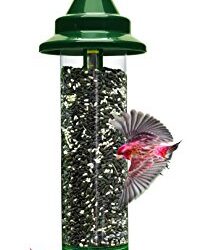
The Squirrel Buster Classic is a tube feeder built around one idea executed well: the seed ports stay open only while something light is using them. Openings in the outer shroud line up with the four feeding ports, and when a squirrel climbs on, its weight pulls the shroud down and covers every port at once. The spring is calibrated so small songbirds feed freely while heavier visitors are shut out, and the birds are never harmed in the process. A patented seed ventilation system lets hot, humid air escape upward, which keeps the seed inside fresher for longer between refills.
Specs
- Feeder type: hanging tube feeder
- Seed capacity: 2.4 lb (1.4 qt)
- Feeding ports: 4, with removable perches
- Dimensions: 4 in L x 4 in W x 21 in H
- Item weight: 2.2 lb
- Materials: metal and plastic, UV resistant
- Model number: 1015-V01
Best for: yards where squirrels currently win every day, and birders who mainly host chickadees, finches, nuthatches, titmice and other small perching or clinging birds.
Watch out for: the mechanism only works if a squirrel has to put its weight on the feeder, so Brome specifies at least 18 inches of clearance on all sides; hang it where nothing can reach across. Capacity is modest, so a very busy station will need frequent refills.
Nature’s Way Squirrel Shield Hopper Feeder

The Squirrel Shield is a metal hopper feeder in a farmhouse style, built for volume. Its reservoir holds 5.5 quarts of seed and feeds from both sides at once, with sixteen feeding ports spread across dual-sided perches, so a crowd of birds can eat without queuing for a single tray. The squirrel defense here is different from the Brome: the perches are weight-sensitive and collapse under a heavier animal, dropping the visitor away from the seed instead of closing a shutter. Viewing windows on the hopper walls let you check the seed level at a glance from the house.
Specs
- Feeder type: hanging hopper feeder
- Seed capacity: 5.5 qt
- Feeding ports: 16 across two sides
- Dimensions: 10.5 in L x 10.63 in W x 10.75 in H
- Material: metal
- Roof: hinged and locking, opens wide for filling
- Model number: SPHOP-1
Best for: households that want fewer refill trips, mixed flocks that feed in groups, and anyone who prefers a classic house-shaped feeder that cardinals and jays can use comfortably.
Watch out for: the collapsing perch defense depends on the squirrel actually standing on a perch, and the feeder is wide and fairly heavy once filled, so it needs a sturdy branch or bracket. Sixteen ports also mean more surfaces to brush clean.
DutchCrafters Amish Platform Bird Feeder

This open platform feeder takes the opposite approach to the two hanging models: instead of restricting who can eat, it welcomes everything. The raised tray stands on the ground or a deck and presents seed on a flat, open surface, which is exactly what ground-feeding birds look for and what larger birds like doves and jays prefer. It is handmade in Indiana by Amish craftspeople from poly lumber, a dense material made from recycled plastic, and the tray floor is aluminum mesh with small drainage holes so rain passes through instead of pooling in the seed.
Specs
- Feeder type: freestanding platform (ground) feeder
- Dimensions: 17 in L x 12.75 in W x 6 in H
- Item weight: 3 lb 2 oz
- Material: poly lumber from recycled plastic
- Tray floor: aluminum mesh with 1/16 in drainage holes
- Hardware: stainless steel
- Raised design keeps seed off the ground
Best for: attracting juncos, towhees, doves, cardinals and other species that feed on flat surfaces, and for anyone who wants a feeder that can simply be rinsed and left to air dry.
Watch out for: an open tray has no squirrel defense at all and no roof, so seed gets wet in rain and needs replacing more often. Place it where you can reach it daily, and expect every neighborhood animal to visit at least once.
Which One Fits Your Situation
- Squirrels empty your current feeder within hours: choose the Squirrel Buster Classic. Its closing shroud is the strongest mechanical defense in this guide, provided you hang it with the clearance the design needs.
- You feed a crowd and hate refilling: choose the Nature’s Way Squirrel Shield. The 5.5 quart hopper and sixteen ports across two sides keep a busy station running far longer between trips outside.
- The birds you love most never use hanging feeders: choose the DutchCrafters platform. Juncos, doves and towhees feed on flat ground by instinct, and an open raised tray is the feeder that finally includes them.
- You are starting from zero on a small patio: start with the Squirrel Buster Classic hung from a shepherd’s hook, then add the platform tray later if ground-feeding species show up and have nothing to land on.
Common Mistakes
- Hanging a weight-activated feeder tight against a tree trunk or fence, which lets squirrels lean across and feed without ever triggering the mechanism.
- Buying capacity far beyond your bird traffic, then leaving the same seed sitting through weeks of damp weather until it clumps or molds.
- Filling a tube feeder with a fine seed mix meant for trays, so small seeds clog the ports or spill straight through.
- Placing a platform feeder and never cleaning it, even though open trays collect droppings and rain-soaked seed faster than any enclosed design.
- Giving up after three quiet days; new feeders often need a week or more before local birds trust and map them.
Frequently Asked Questions
How long does it take for birds to find a new feeder?
Most yards see the first visitors within a few days, but a full regular crowd can take two to four weeks to build. Chickadees and titmice are usually the pioneers because they explore new food sources quickly, and other species follow once they see birds feeding safely. Scattering a small amount of seed on the ground or a nearby surface below the feeder helps birds notice it. Keep the feeder filled and in one place during this period, since moving it restarts the process.
What seed should I put in each feeder type?
Black oil sunflower seed is the safest all-round choice for tube and hopper feeders, because a wide range of songbirds eat it and the shells open easily. Safflower is a useful alternative in the hopper when squirrels or grackles dominate, since many pest visitors dislike its taste while cardinals still eat it readily. On a platform tray you can add cracked corn, millet and peanut pieces for ground-feeding species. Avoid mixes heavy in milo or wheat, which most backyard birds pick around and kick onto the ground.
Where is the best place to hang a bird feeder?
Hang it where birds feel safe and you can see it: within a few feet of shrubs or a tree that gives small birds an escape route from hawks, but with open clearance immediately around the feeder itself so squirrels cannot bridge across. For weight-activated models like the Squirrel Buster Classic, that clearance needs to be at least 18 inches in every direction. A spot visible from a window you pass often also makes it far more likely you will notice an empty or dirty feeder.
How often should I clean a bird feeder?
A sensible rhythm is a full wash every two weeks, and sooner whenever seed gets soaked, clumps together, or the tray looks soiled. Take the feeder down, empty it completely, scrub it with warm soapy water, rinse well and let it dry fully before refilling. Tube feeders that dismantle by hand, like the Squirrel Buster Classic, make this much easier. During periods when sick birds are reported in your area, clean more often and consider pausing feeding for a week.
Will a squirrel-proof feeder also stop large pest birds?
Sometimes. Weight-based designs respond to anything heavy, so a large grackle or a heavy jay can trigger the same closing shroud or collapsing perch that stops a squirrel, depending on the model and its calibration. Cages and smaller port openings are the more targeted answer for pest birds. On a platform feeder there is no barrier at all, so if pest birds become a problem there, the usual fix is switching the tray food to something they ignore rather than changing the feeder.
Closing
The best bird feeder is the one matched to your birds, your refill habits and your squirrel situation. Pick the Squirrel Buster Classic if pests are your main battle, the Nature’s Way hopper if volume and group feeding matter most, and the DutchCrafters platform if the species you enjoy most feed on the ground. Set it up with proper clearance, keep the seed fresh, clean it on a rhythm, and the station will reward you with steady visitors through every season.
Related guides
More from Amazon
Programs that pair well with the guide above. Offers and eligibility are set by Amazon and may change.
Free shipping on eligible items, Prime Video and more. Eligible new members can start with a free trial.
Start a Prime free trialAudiobooks and podcasts to listen to on the go. Eligible new members can start with a free trial.
Try Audible freeAd-free music streaming. Eligible new subscribers can start with a free trial.
Try Music Unlimited freeA free business account with business pricing and bulk-buying tools for work, shop or home office.
Create a business accountAs an Amazon Associate we earn from qualifying purchases.

Write Your Review
No reviews yet. Be the first to share your experience!