
Key takeaways
- Compare bird feeders for cardinals with roomy perches, platform space and safflower-ready ports, plus capacity, seed and mounting tips for backyard setups.
What's inside
As an Amazon Associate I earn from qualifying purchases. This post may contain affiliate links at no extra cost to you.
Cardinals are ground-feeding birds by habit, and that single fact explains why so many feeders fail to hold them for long. A northern cardinal is heavier than a finch, prefers to face its food while it eats, and feels exposed on a narrow peg that forces it to twist sideways. Feeders that work for cardinals give the bird a stable ledge, a ring, or an open tray to stand on, enough room for its crest and tail, and seed it can crack with a thick bill, such as black oil sunflower and safflower.
The strongest fit here is the Brome Squirrel Buster Plus, built around a dedicated Cardinal Ring that lets the bird perch facing the ports. Close behind it, the Nature’s Way CWF3 Cedar Platform Tray Feeder takes the opposite approach, offering a flat open surface that matches how cardinals naturally feed. This guide is for backyard birders who see cardinals passing through but not staying, for households tired of squirrels emptying a feeder before cardinals arrive, and for anyone setting up a first feeding station aimed at larger songbirds. Every pick was chosen from Amazon listings, comparing target species, perch design, seed capacity, and the seed types each listing names.
Quick Picks
As an Amazon Associate we earn from qualifying purchases.
| Product | Best for | Key spec |
|---|---|---|
| Brome Squirrel Buster Plus | Cardinals that need to face their food | Cardinal Ring System with 6 feeding ports and 5.1 lb seed capacity |
| Nature’s Way CWF3 Cedar Platform Tray Feeder | Open tray feeding on a flat ledge | 12 x 12 inch cedar platform with removable Fresh Seed tray |
| Droll Yankees Yankee Flipper | Busy yards where squirrels dominate | Weight-activated motorized perch ring with 5 lb seed capacity |
How to Choose
Perch shape matters more than port count
A cardinal feeds most comfortably when it can face the seed opening directly. Brome states this plainly in its listing: cardinals have difficulty turning their heads to feed, which is why the Squirrel Buster Plus uses a ring the bird grips while facing inward. When you compare listings, look for a ring, a wraparound ledge, or a flat tray edge rather than short straight pegs. Pegs sized for finches leave a cardinal balancing at an angle, and many birds simply drop to the ground instead of fighting for position.
Match the feeder to cardinal seed preferences
Listings for cardinal-friendly feeders consistently name black oil sunflower and safflower, and safflower carries a second benefit because many squirrels and blackbirds leave it alone. Check that the ports or tray can handle larger seed without clogging. A tube with generous ports suits sunflower seed in the shell, while an open tray accepts almost anything, including peanut pieces and dried fruit. If a listing only mentions tiny seed such as Nyjer, that feeder is aimed at finches, not at a thick-billed cardinal.
Decide how you will handle squirrels
Cardinals and squirrels want the same seed, so the feeder design has to separate them. Weight-activated designs close the ports or move the perch when something far heavier than a cardinal lands, and Brome notes its mechanism is adjustable, so the threshold can be set with larger songbirds in mind. An open platform has no such defense, which means placement, a pole baffle, and safflower seed do the work instead. Neither route is wrong, but buying a tray feeder and expecting built-in squirrel resistance leads to disappointment.
Weigh capacity against freshness
A 5 lb hopper reduces refill trips during cold snaps when cardinals feed heavily at dawn and dusk. The trade-off is that seed sitting for weeks in damp weather can cake or spoil, especially in an enclosed tube. A tray holds less and exposes seed to rain, yet it empties and gets cleaned quickly, so seed turns over fast. Think about your routine honestly: a large capacity feeder suits a household that checks it weekly, while a tray suits someone happy to top up smaller amounts every few days.
Plan the mounting before you buy
Cardinals prefer a feeder they can approach from nearby cover, roughly at eye level, with a clear view of approaching predators. Check what each listing includes and what it leaves out. The Squirrel Buster Plus can hang or mount on a pole, but the pole adaptor is listed as a separate purchase. The cedar tray hangs from its vinyl-coated steel cable, and the Yankee Flipper hangs from a looped bail wire. Brome also asks for at least 18 inches of clearance around its feeder so the closing mechanism works as designed and squirrels cannot lean in from a branch.
The 3 Best Options
Brome Squirrel Buster Plus — OUR TOP PICK

This is the rare tube feeder engineered around the way a cardinal actually feeds. The included Cardinal Ring gives the bird a secure, textured perch that wraps the feeder, so it can face the ports squarely instead of perching sideways. Six feeding ports spread birds around the tube, and the weight-activated shroud slides down to close those ports when a squirrel climbs on. The mechanism is adjustable, the feeder dismantles by hand for washing without tools, and every part is designed to be replaceable rather than disposable. For a yard where cardinals visit but squirrels rule the current feeder, this design answers both problems at once.
Specs
- Seed capacity: 5.1 lb, listed as 3 quarts
- Feeding ports: 6, with the Cardinal Ring System included
- Seed types named in the listing: black sunflower, safflower, mixed seed, dried mealworms
- Target species in the listing: cardinal
- Mounting: hanging, or pole mounting with the adaptor listed separately
- Construction: dismantles by hand, no tools required, replaceable parts
Best for: Cardinal watchers who want a hanging feeder that welcomes larger songbirds while shutting out squirrels.
Watch out for: The pole adaptor and weather guard are separate accessories, and the feeder needs open clearance on all sides so a squirrel cannot reach across from a railing or branch and feed without triggering the shroud.
Nature’s Way CWF3 Cedar Platform Tray Feeder
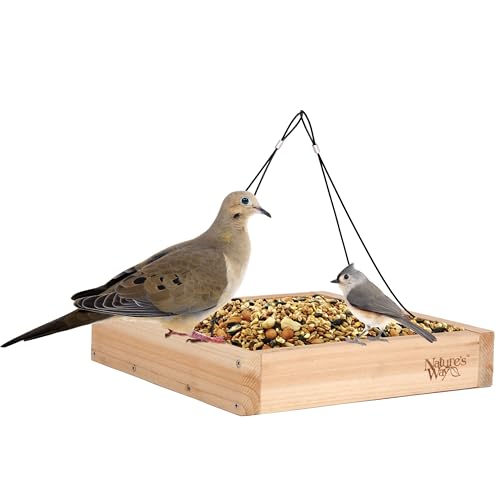
Where the Brome manages access, this tray removes barriers entirely. The listing highlights extra spacing to accommodate large birds like cardinals and jays, and a cardinal that will not use a tube will often step onto an open platform within days because it mirrors feeding on the ground, only raised and drier. The platform is premium cedar with stainless steel screws, and the perforated Fresh Seed tray lifts out for cleaning while letting water drain and air circulate so seed stays fresher. That removable tray matters for cardinals in particular, since they feed at the surface and are quick to abandon a feeder with musty seed.
Specs
- Platform size: 12 x 12 inches, with a 2.25 inch raised profile
- Seed capacity: 3 quarts per the maker comparison chart
- Material: premium cedar, naturally rot resistant
- Hardware: stainless steel screws and a vinyl-coated steel hanging cable
- Tray: removable Fresh Seed tray, powder-coated galvanized steel, perforated for drainage
- Target birds named by the maker: cardinals, grosbeaks, titmice, nuthatches, chickadees, finches, jays, juncos, woodpeckers
Best for: Birders whose cardinals ignore tube feeders, and anyone who wants one open station that also welcomes jays, grosbeaks, and doves.
Watch out for: An open tray has no squirrel defense and no weather cover, so seed gets wet in rain and squirrels can sit in it freely unless you add a baffle, choose safflower, or bring the feeder in during storms.
Droll Yankees Yankee Flipper

The Yankee Flipper takes the most theatrical route to squirrel control: a motorized perch ring that spins when a squirrel’s weight activates it, gently tossing the animal off. The important detail for this guide is the calibration. Droll Yankees states the perch is set to support the weight of even large birds like cardinals and woodpeckers, so cardinals feed undisturbed while heavier raiders trigger the motor. The long polycarbonate tube holds a generous amount of seed across four feeding ports, and the perch ring lets a cardinal stand and face the seed rather than cling. It hangs from a looped bail wire and runs on rechargeable, replaceable batteries housed with the encased motor.
Specs
- Seed capacity: 5 lb
- Feeding ports: 4, served by a continuous perch ring
- Tube: polycarbonate chamber, 4.75 inches in diameter and 21 inches long
- Mechanism: weight-activated motorized spinning perch, with collapsible perches
- Power: rechargeable and replaceable batteries, charged before first use
- Target species in the listing: cardinal, chickadees, finches, grosbeaks, jays, juncos, nuthatches
Best for: Households battling persistent squirrels that have defeated baffles, and birders who want a large tube that still accommodates a cardinal’s size.
Watch out for: The motor depends on charged batteries, so a neglected charge turns the defense off, and the moving ring means this feeder needs hanging room where the spin will not strike a wall or window.
Which One Fits Your Situation
If cardinals already circle your yard but a squirrel claims every refill, start with the Squirrel Buster Plus. Its ring solves the facing problem and its adjustable closing shroud protects a large seed supply between visits.
If your cardinals feed on the ground beneath the feeder and never land on it, choose the Nature’s Way platform. Scatter a little safflower on the tray at first, keep it near shrubs they already use for cover, and let their natural ground-feeding habit do the rest.
If squirrels treat your yard like a gymnasium and you enjoy a bit of theater with your birding, the Yankee Flipper fits. It suits a hanging spot with open space around it, away from walls, where the spinning ring has room to work.
If you feed from a small balcony or patio, the cedar tray is the easiest of the three to manage, since it is light, simple to lift down, and quick to scrub, though you will refill it more often than the two large tubes.
Common Mistakes
- Filling a cardinal feeder with a finch blend heavy in millet and Nyjer, then wondering why cardinals stay on the ground.
- Hanging a tube with short pegs and assuming a cardinal will adapt, when its body and bill are built for a ledge or ring.
- Placing a weight-activated feeder within leaping distance of a fence, so squirrels feed from the side without ever loading the mechanism.
- Letting seed sit until it cakes in the bottom of a large tube instead of emptying and washing the feeder on a regular cycle.
- Mounting an open tray in full weather with no drainage check, leaving cardinals to pick through soaked, sprouting seed.
Frequently Asked Questions
Why do cardinals visit my yard but refuse my tube feeder?
Most tubes are built around small birds that can twist to a port from a short perch. Cardinals prefer to face their food, and many will not feed at an angle for long. A ring perch, a wraparound ledge, or a flat tray removes that barrier, which is why the feeders in this guide are built around those three shapes.
Which seed should I put out first for cardinals?
Black oil sunflower is the reliable starting point because the shell is thin enough for a cardinal’s bill and the kernel is rich. Safflower is the strategic second choice: cardinals eat it readily, while many squirrels and blackbirds pass it by, so a tray of safflower often becomes a quieter, cardinal-led station.
Will a weight-activated feeder scare cardinals away?
The mechanisms in these listings respond to weight, not to movement or sound during normal feeding. Brome describes an adjustable threshold, and Droll Yankees states its perch is calibrated to carry large birds like cardinals and woodpeckers. A cardinal feeding normally should not trigger either design, though any new feeder needs a few days before wary birds trust it.
How high should a cardinal feeder hang?
Eye level is a practical target, roughly five feet, close enough to shrubs or a small tree that cardinals can retreat to cover, but far enough from branches that squirrels cannot jump across. For the Squirrel Buster Plus, keep the maker’s recommended clearance of at least 18 inches on every side so the shroud can move freely.
How often does a platform tray need cleaning?
More often than a tube, because the seed sits exposed and birds stand in it. Lift the tray out, discard damp seed, scrub the perforated surface, and let it dry before refilling. In wet weeks that may mean a quick clean every few days, which is the honest trade for the open design cardinals love.
Cardinals reward small design concessions generously: a place to stand, a clear view, and seed worth cracking. Pick the feeder that matches how your birds already behave, set it near cover, and keep the seed fresh, and the red flash at the feeder tends to become a daily appointment rather than a rare sighting.
Related guides
More from Amazon
Programs that pair well with the guide above. Offers and eligibility are set by Amazon and may change.
Free shipping on eligible items, Prime Video and more. Eligible new members can start with a free trial.
Start a Prime free trialAudiobooks and podcasts to listen to on the go. Eligible new members can start with a free trial.
Try Audible freeAd-free music streaming. Eligible new subscribers can start with a free trial.
Try Music Unlimited freeA free business account with business pricing and bulk-buying tools for work, shop or home office.
Create a business accountAs an Amazon Associate we earn from qualifying purchases.


Write Your Review
No reviews yet. Be the first to share your experience!